
Dropshipping vs Affiliate Marketing: Which Business Model is Easier in 2025?
Starting an online business is the dream, but the path isn’t always clear. The two most popular “low-cost” entry points are Dropshipping and Affiliate Marketing. Both promise financial freedom without storing inventory, but they function very differently.
If you are a beginner asking, “Which one is actually easier?” or “Which one makes more money?”, this guide is for you. We will compare them head-to-head on startup costs, risk, and scalability.
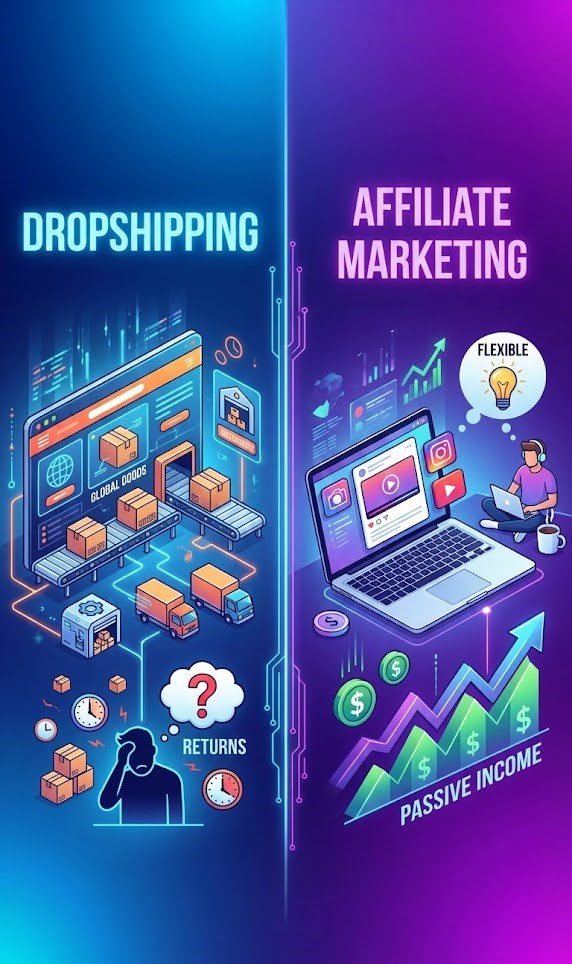
What is the Core Difference?
Before we declare a winner, let’s simplify the definitions:
Dropshipping is where you run an online store (like Shopify). You sell products at a markup, and when a customer orders, your supplier ships it directly to them. You handle the marketing, the store, and the customer service.
Affiliate Marketing is where you promote someone else’s products via a unique link. When someone buys through your link, you get a commission. You handle the marketing, but not the store or the customer.
Comparison at a Glance
Feature | Dropshipping | Affiliate Marketing |
|---|---|---|
Startup Cost | Medium ($100 – $500+) | Low/Free ($0 – $100) |
Profit Margins | High (20% – 40%) | Low to Medium (5% – 50%) |
Customer Service | You are responsible | Not your problem |
Control | High (You own the brand) | Low (You depend on the vendor) |
Skill Curve | Steep (Ads, Web Design, Logistics) | Moderate (Content, Copywriting) |
Round 1: Which is Easier to Start?
Winner: Affiliate Marketing
Affiliate marketing is strictly “plug and play.” You don’t need to build a website (you can start on TikTok, Pinterest, or YouTube). You don’t need to worry about shipping times, returns, or angry customers. You simply find a product, get a link, and start driving traffic.
Dropshipping requires you to build a trustworthy store, find reliable suppliers (which is hard), and set up payment gateways.
Round 2: Which Makes More Money?
Winner: Dropshipping
In Affiliate Marketing, your income is capped by the commission rate. If you sell a $100 product with a 10% commission, you make $10.
In Dropshipping, you set the price. If you source a product for $10 and sell it for $40, you keep the $30 gross profit. Furthermore, dropshipping allows you to build a brand. A brand is an asset you can sell later for millions. You cannot “sell” an affiliate link business as easily.
Round 3: The Risk Factor
Winner: Affiliate Marketing
Dropshipping involves financial risk. You typically need to run Facebook or TikTok ads to get sales. If your ads don’t work, you lose that money. Plus, if a supplier sends a broken product, you have to refund the customer out of your own pocket.
Affiliate marketing has almost zero financial risk. If you post content and no one buys, you’ve only lost your time.
The Final Verdict: Which Should You Choose?
Choose Affiliate Marketing if:
You have zero budget.
You hate the idea of dealing with customer complaints.
You are a good content creator or influencer.
You want a “side hustle” rather than a full-time business management job.
Choose Dropshipping if:
You want to build a real brand and asset.
You want higher profit margins.
You are willing to learn skills like website design and paid advertising.
You want control over the customer experience.
Conclusion
If “Easy” is your only metric, Affiliate Marketing wins. But if “Wealth Creation” is your metric, Dropshipping wins. The best strategy for 2025? Start with affiliate marketing to build capital, then use that money to launch your own branded dropshipping store.
